

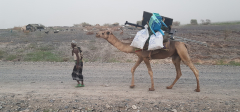
In Ethiopia’s Afar region, camels carry school supplies along the routes families travel with their herds. At a primary school in Addis Ababa, families bring a pad and a bar of soap at enrolment to keep a menstrual health space stocked. These two stories show how Development Expertise Center (DEC) works with communities to remove barriers that make it harder for girls to attend school and take part in class.
From mobile classrooms in Afar to a self sustaining Safe Corner in Addis Ababa
By: Development Expertise Center (DEC)
For Development Expertise Center, gender equality is not measured only by how many girls or women enter a program. It is measured by whether people with different needs and barriers can participate, influence decisions and benefit fairly.
In Ethiopia's Afar Region, a father described what this can mean in everyday life. Before a mobile school reached his community, his daughter spent part of her day walking long distances to collect water. Schooling had to compete with that responsibility. After the classroom began moving with pastoralist families, he said:
“My daughter used to fetch water far away. Now she waits for the camel.”
Father participating in DEC's Afar mobile school study
His words capture the difference between equal access and equity. A school may officially be open to every child, but distance, seasonal migration, disability, domestic work and safety risks can still exclude some children in practice. Instead of asking the girl to fit a fixed system, DEC adapted the system to her life.
Equality starts with understanding difference
Development Expertise Center is an Ethiopian civil society organization that has worked with children, young people, families, schools and communities since 2007. It is also one of the organizations in the Change the Game Academy Alliance since 2016. Gender equality and social inclusion cut across DEC's work on gender based violence prevention, youth leadership, inclusive education, sexual and reproductive health and rights, adolescent wellbeing, economic empowerment, harmful norm change, and community and government systems.
DEC begins with Gender Equality and Social Inclusion analysis. It examines the needs, opportunities and barriers experienced by different groups, recognizing that girls, boys, women and men are not uniform categories. Age, disability, poverty, location, household responsibilities and social norms shape who can participate and benefit. The findings guide program design, budgeting, implementation and monitoring, so success is assessed beyond attendance figures.
This is equity in practice: people are not given identical support; they receive what they need for a fair opportunity to participate and succeed.
When the classroom follows the community
DEC's camel mounted mobile school model in Afar shows how this analysis changes program design. Supported by Kindernothilfe and building on learning from the Fit for Better Life project, DEC developed a model in which classrooms and learning materials move along pastoralist migration routes.
“We follow the camels. If the school didn't move with us, no child would attend. Learning walks with life.”
Clan elder participating in the mobile school study
The model aligns school movement with local migratory calendars and uses culturally relevant teaching, including local languages and storytelling. Enrollment increased by approximately 40 percent, with girls' participation rising notably. Reduced travel lowered safety risks and opportunity costs, while community adaptations improved access for children with disabilities.
Equity also changed who managed education. Clan leaders coordinated security and site selection; mothers supported classroom setup; and parents and women's groups participated in governance, resource allocation and child protection. As one mother explained, “We didn't just receive the school, we built it, moved it, and protected it.”
Practical access and deeper transformation
Removing an immediate barrier does not automatically change the conditions that created inequality. DEC therefore combines gender responsive and socially inclusive programming with a Gender Transformative Approach, which is included among DEC's principles for GESI mainstreaming. Practical support addresses immediate needs, while transformative work tackles harmful norms, unequal power relations and control over resources.
This includes community conversations, economic empowerment, engagement of fathers, boys, elders and religious leaders, and direct investment in the leadership and agency of women and girls. DEC works through existing structures such as school gender clubs, Parent Teacher Student Associations, youth councils, women's groups and local government offices so that change can continue beyond a project cycle.
A Safe Corner becomes a school responsibility
At Misrak Ber 1 Primary School in Addis Ababa, DEC's Right Here Right Now 2 program established a Safe Corner where girls could obtain menstrual hygiene supplies and manage menstruation with dignity. DEC's school based research found reduced absenteeism, improved girls' participation and more positive attitudes among male students involved in awareness activities.
When project funding ended, the room remained but its supply of pads and soap was at risk. Through Change the Game Academy's Local Fundraising Program, teachers, school administrators and PTSA members learned to identify resources within their community and sustain valued initiatives without waiting for another donor.
The school connected the solution to annual registration. Every family registering a child now contributes one sanitary pad and one bar of soap, including families registering sons. The mechanism renews the supply through the school's own calendar. It also reframes menstrual health as a shared responsibility rather than a private burden for girls. DEC helped establish the service, CTGA strengthened local fundraising capacity, and the school community decided how the solution would continue.
The measure of meaningful inclusion
The Afar mobile schools and the Addis Ababa Safe Corner reveal the same approach. DEC redesigns programs around people's different realities while strengthening the community structures and power needed to sustain change. Challenges remain, including inadequate WASH facilities, limited inclusive learning materials, teacher retention, security disruptions, menstrual supply gaps and persistent taboos. Acknowledging these constraints is part of understanding what lasting change requires.
Equality is the destination, equity determines the route, and transformation helps the progress last.
A girl waiting for a mobile classroom instead of walking away from education, a mother helping govern the school her community moves and protects, and a PTSA sustaining menstrual supplies through its own registration system show what meaningful inclusion looks like: access, voice, ownership and the power to carry change forward.